


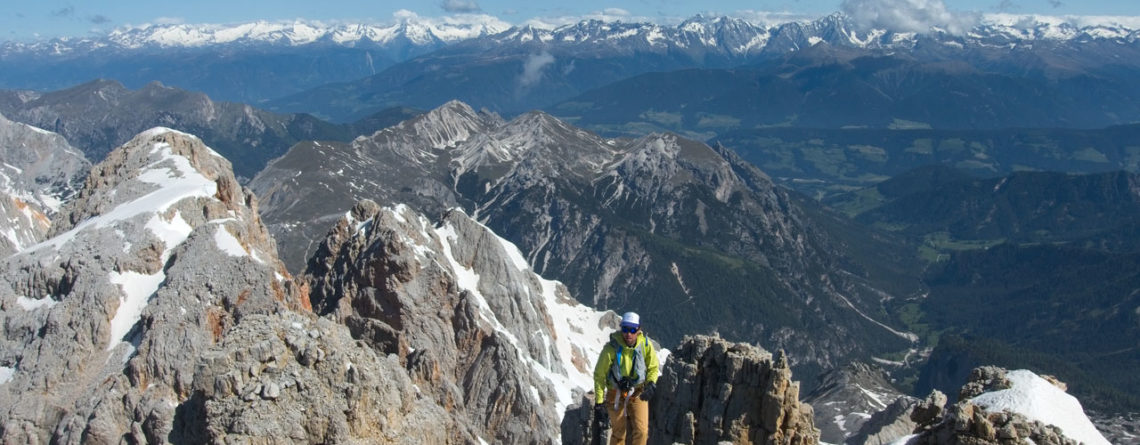
Croda Rossa d’Ampezzo, Grohmann Route
“The Croda Rossa d’Ampezzo is notoriously an extremely impervious and wild mountain, with friable and difficult to climb rock. Of all the 3,000 of the Dolomites, it is definitely the most demanding and risky peak.
The normal route from the north west, originally attempted by Grohmann who barely missed the summit, is the easiest route and with less technical difficulties, but it takes place along a very steep, slippery and landslide clay basin and reddish rocks, often wet or with glass and with frequent unloading of stones in bad weather, which makes the ascent and descent extremely precarious and risky.
The absolute friability of the ground and of the rock, until reaching the fork on the west ridge in the upper part of the route, suggests to evaluate very carefully whether to make the climb from this side “
How not to be fascinated and curious but at the same time afraid of this introduction read on the description of the climb on the book “3000 of the Dolomites, the normal routes”
It was really many years that I wanted to climb this wild 3000 but between one thing and another but above all because of its bad reputation as “marzumera” I always put off and preferred to do something else …
Whichever side you look at it, it remains steep and “inaccessible”.
Although it is a mountain (understood as an area) very popular both in winter, with the numerous ski mountaineers that run alongside it (Forcella Colfiedo for example), or in summer with the numerous walks on its beautiful basal meadows (side Prato Piazza for example ), its summit remains a satisfaction for very few.
When Albi two days ago asked me to do an “escapade” on the Croda Rossa, the desire for adventure and the curiosity to discover this difficult summit immediately rekindled
We decide to climb the Grohmann route climbed for the first time in 1865 by Paul Grohmann accompanied by the guide Angelo Dimai and the hunter Fulgenzio Dimai, who however stopped at the base of a fireplace, considered impossible to overcome, a few steps from the summit.
To better face this climb, precisely because of its super unstable rock, it is necessary that there is a good hard and stable snow cover that covers as much as possible the climb.
So that it is so avoid as much as possible to go up in the summer but face it in late spring on days not too hot exactly as we have faced it.
With these conditions it becomes a really pleasant and spectacular mountaineering climb (ice ax and crampons) where the “bloody” gravels of the red basin (the most rotten and dangerous area of the entire route), which from the Val Muntejela rise to a drop at 2940m and damage access to the western ridge, they become a fantastic goulotte (slopes between 50 and 60°) of ice and snow fun, fast and safe to climb, vaguely reminiscent of the climbs of the Western Alps (1 mandatory ice ax, with 2 you go even better in this stretch, about 100m)
From Forcella at 2940 you rejoin the normal route from Forcella Lerosa (climbed by Wachtler and the Ampezzo guide Santo Siorpaes in 1870). The western ridge remains a little rotten but much less than expected and climbs between ledges, exposed passages and ridges, with evident and fairly marked route (some little men and red stamp) with difficulties that never exceed 1st and 2nd degree up to the cross of summit.
A climb (only and exclusively in these conditions) really beautiful and advisable to be tackled however only by expert mountaineers
Climbed from Ra Stua in about 4 hours to the summit and just under 3 hours for the descent (three fully equipped abseil: the first of 15 meters just below the top on the “inaccessible” fireplace and the other two, 50m and 30m , on the “bloody” couloir)
I leave you with the photos of this fantastic adventure


